NerdcoreMedical Presents
CurativeDesign:
The Dai Series
Fifteen new works in medical information design, by physician-artist Alex Dai, MD MPH.
- When
- Friday, 6 November 2026 · 6:00 PM
- Where
- Postmark Center for the Arts · 20 Auburn Avenue, Auburn, WA
- What
- Cocktail reception · remarks by the artist
The Evening
A gallery launch in a prestigious landmark in the heart of Auburn, WA

Drinks, the work on the walls, and short remarks from the NerdcoreMedical team and Dr. Alex Dai on the history of the project and a few insights on select pieces.
A fundraiser for our community
100% of proceeds go to MultiCare Foundations

100% of proceeds from the event go to MultiCare Foundations to support various initiatives in and around Auburn, WA.
About the Artist
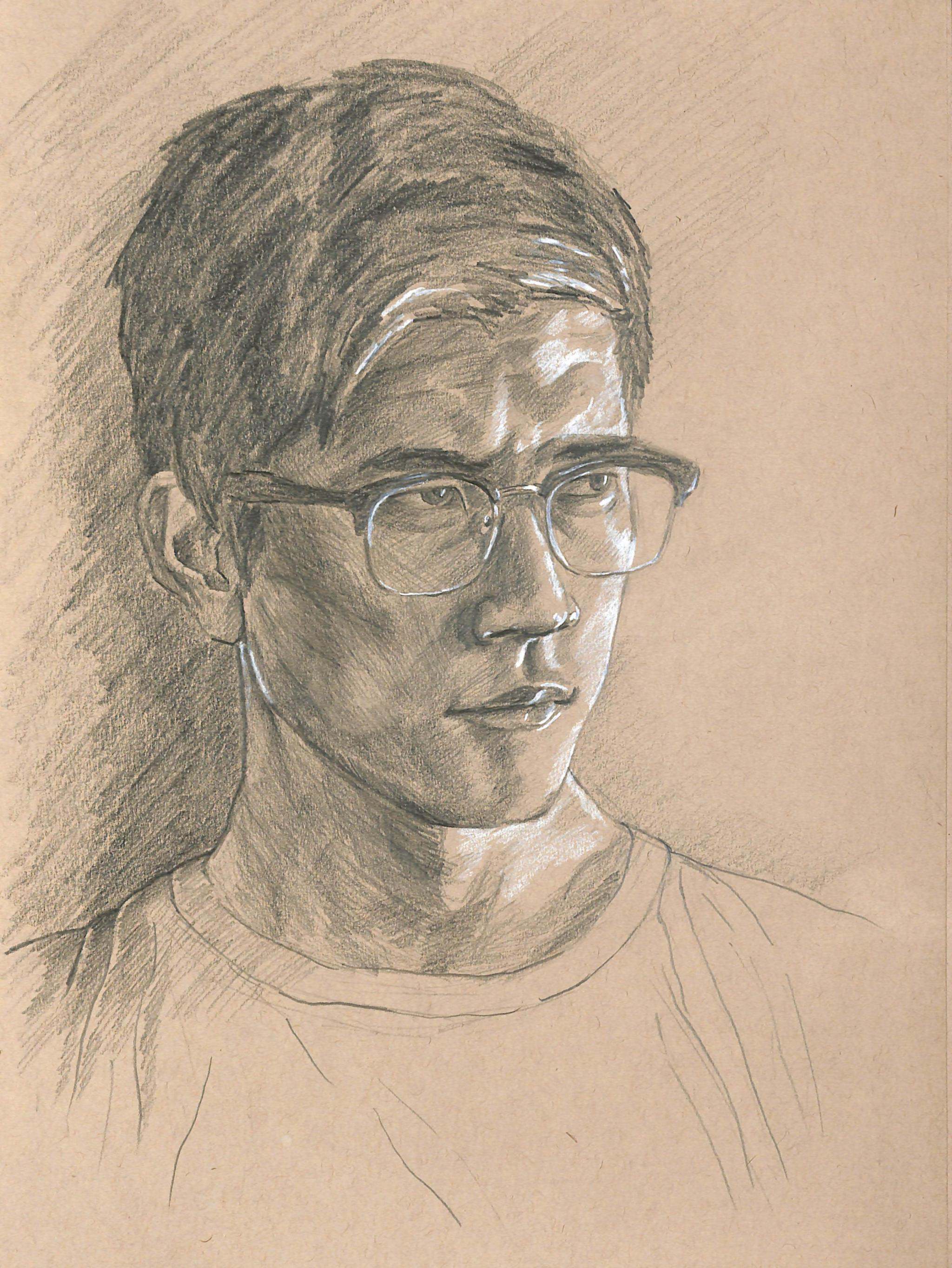
Alex Dai, MD MPH
Alex Dai is a physician-artist working at the intersection of clinical medicine and visual design. He earned his BS at Duke University and his MD and MPH at Tufts University, and is currently a general surgery resident at ECU Health Medical Center in Greenville, North Carolina. Throughout his training he has treated illustration not as decoration, but as a clinical instrument.
His published research includes Art in Surgery, a review of art-based medical humanities curricula in surgical residency published in the Journal of Surgical Education — an argument, in academic form, for the same conviction that drives the Dai Series: that drawing sharpens the surgical eye.
Beyond the studio, he has contributed trauma illustrations to the Global Medical Knowledge Alliance, supporting frontline clinical education where reference material is needed most. The fifteen plates of the Dai Series are his largest body of work to date.
The Project
Medical complexity, made beautiful through the rigor of graphic design
CurativeDesign began with a frustration two physicians had with their own training: that medical education seemed to have been built entirely without reference to design. The material was dense, the stakes were high, and the visual language was an afterthought.
So Drs. Arun and Zeeba Mathews commissioned a series of infographics on the highest-yield topics in clinical medicine — chosen by surveying students preparing for the US medical licensing exams — and asked for one thing beyond accuracy: that a student should want them on the wall. Embryology, anatomy, biochemistry, pharmacology and physiology, met with typography, hierarchy, color and symmetry.
The first twenty plates, designed by Eleanor Lutz, now Mohren, were exhibited at the Museum of the Southwest and subsequently featured in the 2017 Kantar Information is Beautiful Awards showcase in the Science, Technology & Health category. They have been on dormitory and call-room walls ever since.
The Dai Series is the second generation: a new artist, the same brief, and a decade more medicine to draw on.
New Work
Fifteen plates by Alex Dai
A practicing surgeon's eye, turned on the reference charts every clinician carries in their head. Each plate is digitally rendered by a human hand, and will be signed by Dr. Dai at the event. Six plates are previewed below; the full suite of fifteen debuts at the opening.
- Plate 01
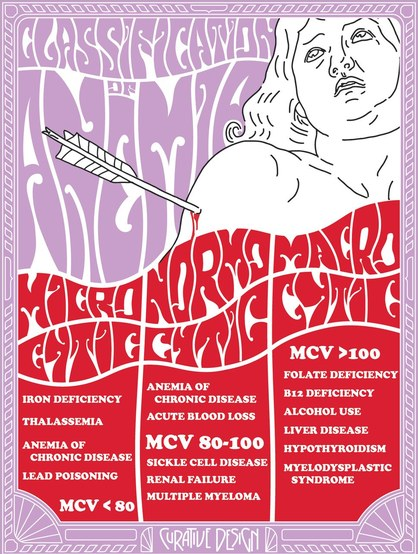
Classifications of Anemia
The full schema by cell size — microcytic, normocytic, macrocytic — set in swirling psychedelic letterforms, from iron deficiency through myelodysplastic syndrome.
- Plate 02
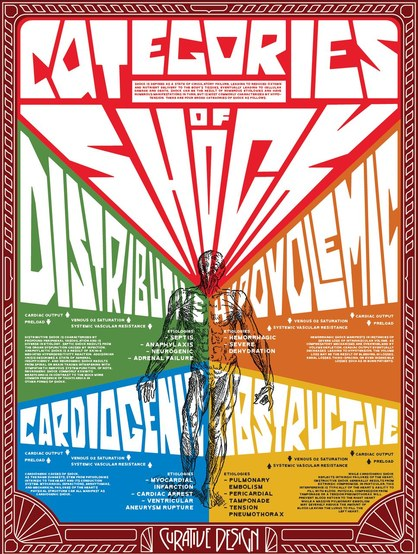
Categories of Shock
Four failures of circulation resolved into one radiating chart: distributive, hypovolemic, cardiogenic and obstructive, each with its signature of cardiac output, preload and vascular resistance.
- Plate 03
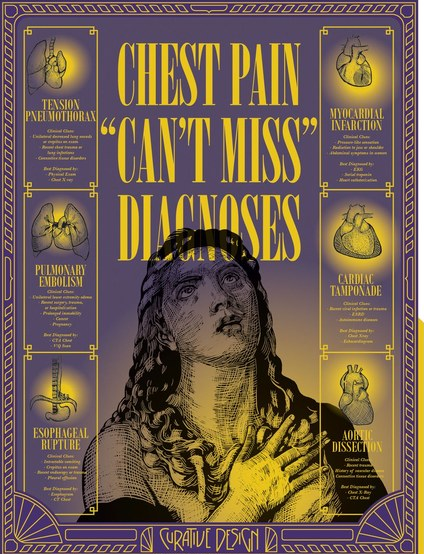
Chest Pain: The Can’t-Miss Diagnoses
Six diagnoses you cannot afford to walk past — tension pneumothorax, pulmonary embolism, esophageal rupture, myocardial infarction, tamponade, aortic dissection — each by its clinical tell and the test that settles it.
- Plate 04
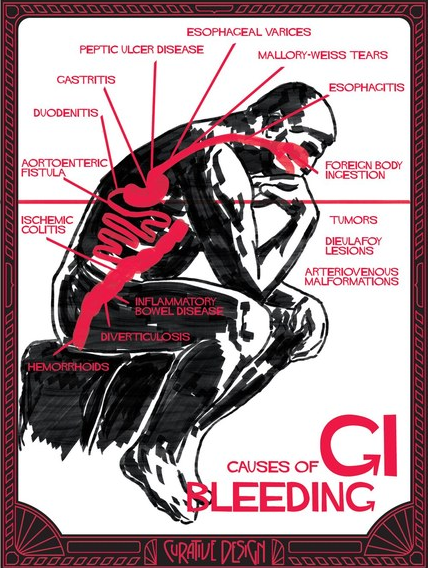
Causes of GI Bleeding
The upper and lower tracts mapped onto Rodin’s Thinker — from esophageal varices to hemorrhoids, every lesion labeled along the length of the gut.
- Plate 05
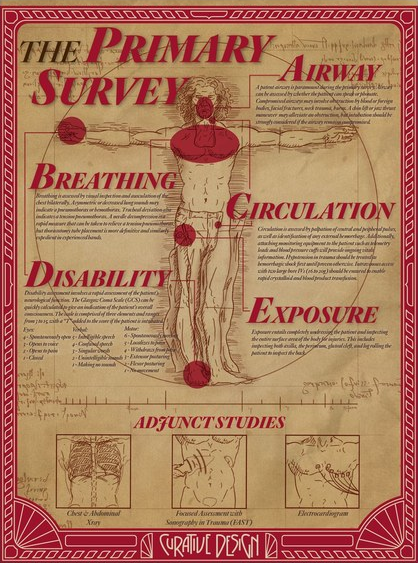
The Primary Survey
Airway, breathing, circulation, disability, exposure — the trauma bay’s first ninety seconds, drawn as a Vitruvian figure with the adjunct studies beneath.
- Plate 06
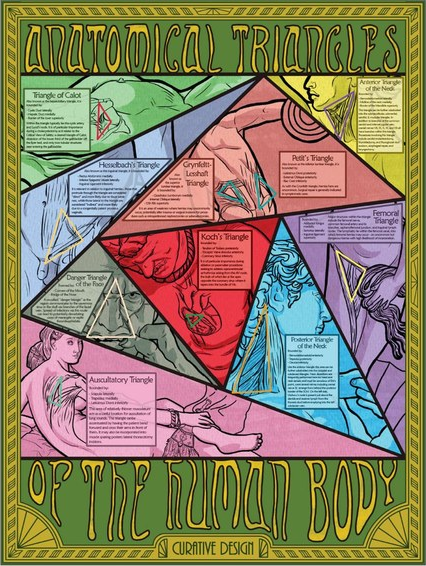
Anatomical Triangles of the Human Body
Hesselbach’s, Calot’s, the danger triangle of the face, and the triangles of the neck — nested figures inside a stained-glass composition of interlocking geometry.
The Venue
A post office, a health clinic, an arts center
MAIL → MEDICINE → ART
Postmark Center for the Arts occupies Auburn's 1937 post office — a Starved Classical building by Louis A. Simon, Supervising Architect of the Treasury, with James I. Barnes, and on the National Register of Historic Places since 2000. King County Public Health bought it in 1964 and ran it as a clinic for decades. The City of Auburn brought it back as an arts center.
Which makes it a fitting room for this particular show. We are hanging medical illustration in a building that has been, in order, a place where information was delivered, a place where care was delivered, and now a place where art is.
CurativeDesign: The Lutz/Mohren Series
The original catalogue
The complete first generation of CurativeDesign, designed by Eleanor Lutz, now Mohren, in print and available for purchase online now.
Acknowledgements
The team
- Artist · The Dai Series
Alex Dai, MD MPH
A general surgery resident at ECU Health Medical Center who draws. Duke for his BS, Tufts for his MD and MPH — and a portfolio that convinced NerdcoreMedical that CurativeDesign could have a second life. He co-authors on art in surgery, and every plate in this series carries his signature.
- Project Lead & Writer
Sasha Fairchok, MSc, MPH
Business Development Lead at NerdcoreMedical and project lead for CurativeDesign. She writes the clinical copy for each plate, commissions the specialist physicians who vet it for accuracy, and keeps the review record that carries a poster from first draft to final print. She brought in the artist behind the second generation and runs its third, holding the standing check-ins that keep both on schedule. Beyond the editorial work she leads partnerships and corporate development, from distribution and investor relations to the company’s international expansion. Trained in public health, based in New Haven, Connecticut.
- Artist · The Original Series
Eleanor Mohren, PhD
Designer of the original twenty plates, working as Eleanor Lutz. A biologist by training — a PhD in biology and data science, and the creator of Tabletop Whale — she drew the first generation while still a graduate student. She went on to the graphics desk of The New York Times, where she shared in the 2021 Pulitzer Prize for Public Service, and now designs for the Dutch national paper de Volkskrant.
- Operations
Brandon Patton
Chief Operating Officer at NerdcoreMedical and the designer of Healing Blade: Defenders of Soma, the studio’s flagship game. He runs everything between a finished drawing and a print in your hands — printing, fulfilment, distribution. Under his own studio, Merlin Pool Creative, he designed Caps & Stems, a three-dimensional mushroom-hunting board game that raised over 2,300% of its Kickstarter goal, from 1,668 backers.
- Founders
Arun & Zeeba Mathews
Two physicians who thought medical education deserved better design, and commissioned it. Both are internists — Arun specialized in clinical informatics, Zeeba in palliative care medicine — and both review every plate for clinical accuracy before it is printed.
- Production
NerdcoreMedical
The medical education studio behind CurativeDesign, the Healing Blade games, and Occam’s Razor — fifteen years of treating clinical accuracy and good design as the same problem.
RSVP
Join us on Friday, 6 November 2026
Space at the Postmark Center is limited. Reserve your place for the cocktail reception, remarks from Dr. Arun Mathews and Dr. Alex Dai, and the first public viewing of the Dai Series.
Admission is by RSVP. 100% of proceeds from the event go to MultiCare Foundations to support various initiatives in and around Auburn, WA.